

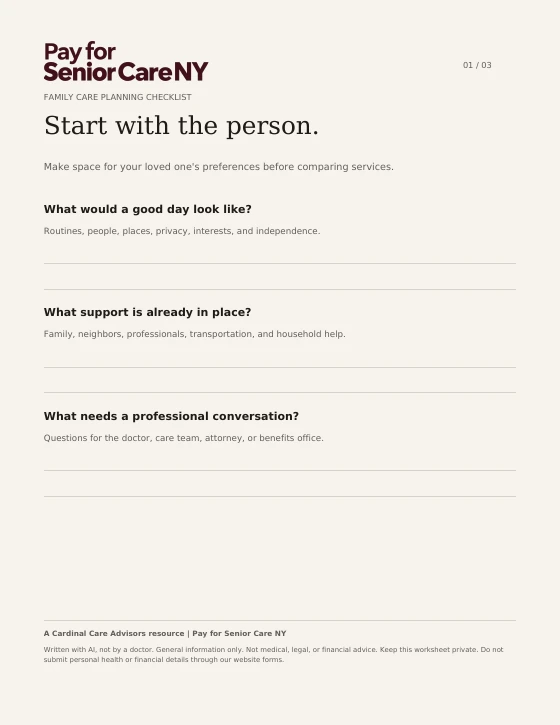


Most New York families pay for senior care with a mix of sources: the older person's own income and savings, the value of their home, long-term care insurance if they have it, and VA benefits if they served. Medicare pays only for short-term rehab and medical care, not ongoing help with daily living. Medicaid pays for long-term nursing home care and home care for people who qualify, and for assisted living only through New York's Assisted Living Program.
If you're reading this, someone you love probably needs more help than they did a year ago — and the first question on your mind is how on earth anyone pays for it. You're not behind. Most families start exactly here.
This guide walks through every way New Yorkers pay for care, in plain English, with 2026 numbers. Every figure is dated and sourced. Where the rules get legal, we say so and point you to the right professional.
What senior care costs in New York right now
Prices depend on the level of care, the part of the state, and the specific community. Here is what families in Western New York are seeing in 2026:
| Type of care | Typical monthly cost in Western NY (2026) |
|---|---|
| Independent living | $1,800–$3,500 per month (estimate) |
| Assisted living | $3,500–$6,500 per month (estimate) |
| Memory care | $5,500–$8,500 per month (estimate) |
| Nursing home (private pay) | about $13,765 (NYS DOH 2026 Western-region average private-pay rate) |
| Home care, 44 hours a week | about $6,700 per month (at the national median of $35 per hour) |
The nursing home figure is New York State's own number: the Department of Health publishes the average private-pay nursing home rate for each region every year. Costs downstate run higher. For the details, see assisted living costs in Buffalo, memory care costs, and nursing home costs in Western New York.
The seven ways New Yorkers pay for care
Almost every family ends up combining two or three of these. It helps to see them all at once.
| Source | What it can pay for | Who it's for |
|---|---|---|
| Income and savings | Anything | Everyone, usually first |
| The house | Anything, once sold, rented, or borrowed against | Homeowners |
| Long-term care insurance | Home care, assisted living, nursing home (depends on the policy) | People who bought a policy years ago |
| VA Aid and Attendance | Any care — paid to the veteran or surviving spouse monthly | Wartime veterans and surviving spouses |
| Medicare | Short-term rehab, medical care, hospice | People 65+ — not for ongoing daily help |
| Medicaid | Nursing homes, home care, and the Assisted Living Program | People with limited income and assets |
| Other programs | Help at home, prescriptions, Medicare costs | Varies by program and county |
1. Income and savings
Social Security, pensions, IRA withdrawals, and savings are where nearly everyone starts. A useful first step is simply writing down the monthly income and total savings, side by side with the monthly cost of the care being considered. That one page tells you how many months private pay can last and which other sources you'll need to line up. Our senior care budget worksheet walks through it.
Care costs may also be tax-deductible as medical expenses, which can soften the bill. See is assisted living tax deductible?
2. The house
For many families the house is the largest asset — and the hardest decision. It can be sold, rented, borrowed against with a home equity line or reverse mortgage, or bridged with a short-term loan while it sells. Each choice affects taxes, Medicaid, and VA eligibility differently. We lay out the trade-offs in using the house to pay for assisted living.
3. Long-term care insurance
If your parent bought a long-term care policy, find it now. Policies usually start paying once a doctor or nurse certifies that the person needs help with two or more activities of daily living, or has a serious cognitive impairment, and after a waiting period of often 30 to 100 days. Here's how to file a claim.
4. VA Aid and Attendance
This is the benefit families most often miss. Wartime veterans and their surviving spouses who need help with daily living may qualify for a monthly, tax-free pension — up to $2,424 per month for a single veteran and $1,558 per month for a surviving spouse, for payments through November 30, 2026. There is a net worth limit of $163,699, and the home generally doesn't count. See VA Aid and Attendance in New York.
5. Medicare
Medicare is health insurance. It does not pay for ongoing help with bathing, dressing, or meals, and it does not pay assisted living rent. What it does cover matters, though: after a qualifying hospital stay, Medicare can cover up to 100 days of skilled rehab in a nursing facility — the first 20 days in full, then $217 per day for days 21–100. It also covers hospice and short-term skilled care at home. See Medicare's 100 days, explained and does Medicare pay for assisted living?
6. Medicaid
Medicaid is the largest payer of long-term care in the country. In New York, it can pay for nursing home care, care at home, and — through the Assisted Living Program — some assisted living. In 2026, a single person generally needs income under $1,836 per month and countable assets under $33,038, though there are ways to qualify with higher income and strong protections for a spouse who stays at home.
Medicaid is where most of the confusion lives, so we've broken it into pieces: income and asset limits, the look-back period, protections for the spouse at home, what happens to the house, and whether Medicaid pays for assisted living.
One date to know: for applications filed on or after January 1, 2027, Medicaid coverage can reach back only up to two months before the month you apply (one month for expansion adults), down from three. Applying promptly matters more than it used to. What's changing in 2027 and 2028.
7. Other New York programs
Several smaller programs fill real gaps: EISEP helps people who don't qualify for Medicaid get care at home on a sliding scale through the county Office for the Aging; CDPAP lets Medicaid recipients hire a family member as a paid caregiver; PACE bundles medical and long-term care so people can stay home; and EPIC and the Medicare Savings Programs lower prescription and Medicare costs. See how to pay for home care in New York.
Who pays for what, by type of care
| Home care | Assisted living | Memory care | Nursing home | |
|---|---|---|---|---|
| Private pay | Yes | Yes | Yes | Yes |
| Long-term care insurance | Usually | Usually | Usually | Yes |
| VA Aid and Attendance | Yes | Yes | Yes | Yes |
| Medicare | Short-term skilled care only | No (medical care only) | No (medical care only) | Up to 100 days of rehab |
| Medicaid | Yes | Only through the ALP | Rarely | Yes |
Always check the specific policy, program, and community — these are the general rules.
Where to start this week
- Write down the numbers. Monthly income, total savings, home value, any insurance policies, and military service.
- Name the level of care honestly. The right level saves money and keeps people safer. Levels of care, translated.
- Check the benefits first. VA and long-term care insurance can take months to start paying. Start those applications early.
- If Medicaid may be needed within five years, talk to an elder law attorney now, not after money has moved.
- If a hospital is involved, slow down the clock. You have rights, including a fast appeal of a discharge you disagree with. The first 72 hours.
If you'd like a person to walk through this with you
Cardinal Care Advisors publishes this guide. We help families in Erie and Niagara counties compare assisted living, memory care, and independent living — and it's free to families. If you'd rather read first, the free guide below covers everything on this page in more depth.